Motivation
Road-network graphs extracted from satellite imagery feed autonomous navigation, urban planning, and disaster response. Getting the pixels right isn't enough: a single missed segment under a tree or overpass breaks every route that passes through it. Foundation models such as SAM, DINO, and RADIO have transformed pixel-level segmentation, but it was unclear which of their representational properties transfer to graph-level topology, where long-range connectivity matters as much as detection.
Approach: a controlled swap
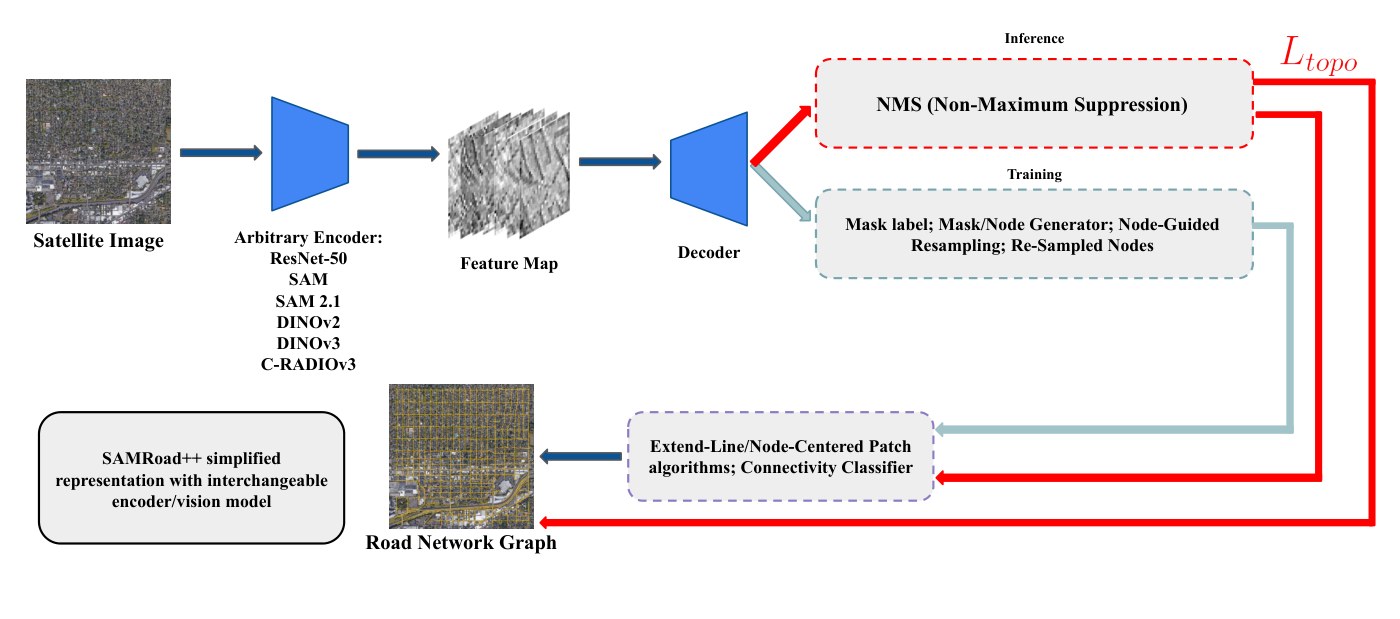
To isolate the effect of the representation, the encoder is the only thing that changes. Everything downstream (decoder, topology reasoning, training recipe, thresholds) is held fixed.
- Backbones: ResNet-50 (supervised baseline), SAM, SAM 2.1, DINOv2, DINOv3, and C-RADIOv3
- Two extraction paradigms: a sparse point-proposal pipeline (SAMRoad++) and a dense graph-tensor-encoding pipeline (Sat2Graph-style)
- Architectural add-ons: Feature Pyramid Networks and CBAM attention, alone and combined
- Data: CityScale (20 U.S. cities), plus GlobalScale (3,338 tiles worldwide) with an out-of-domain split of entirely unseen geographies
- Metrics: TOPO precision/recall/F1, and APLS (Average Path Length Similarity) as the primary metric, since it directly measures routing fidelity
Findings
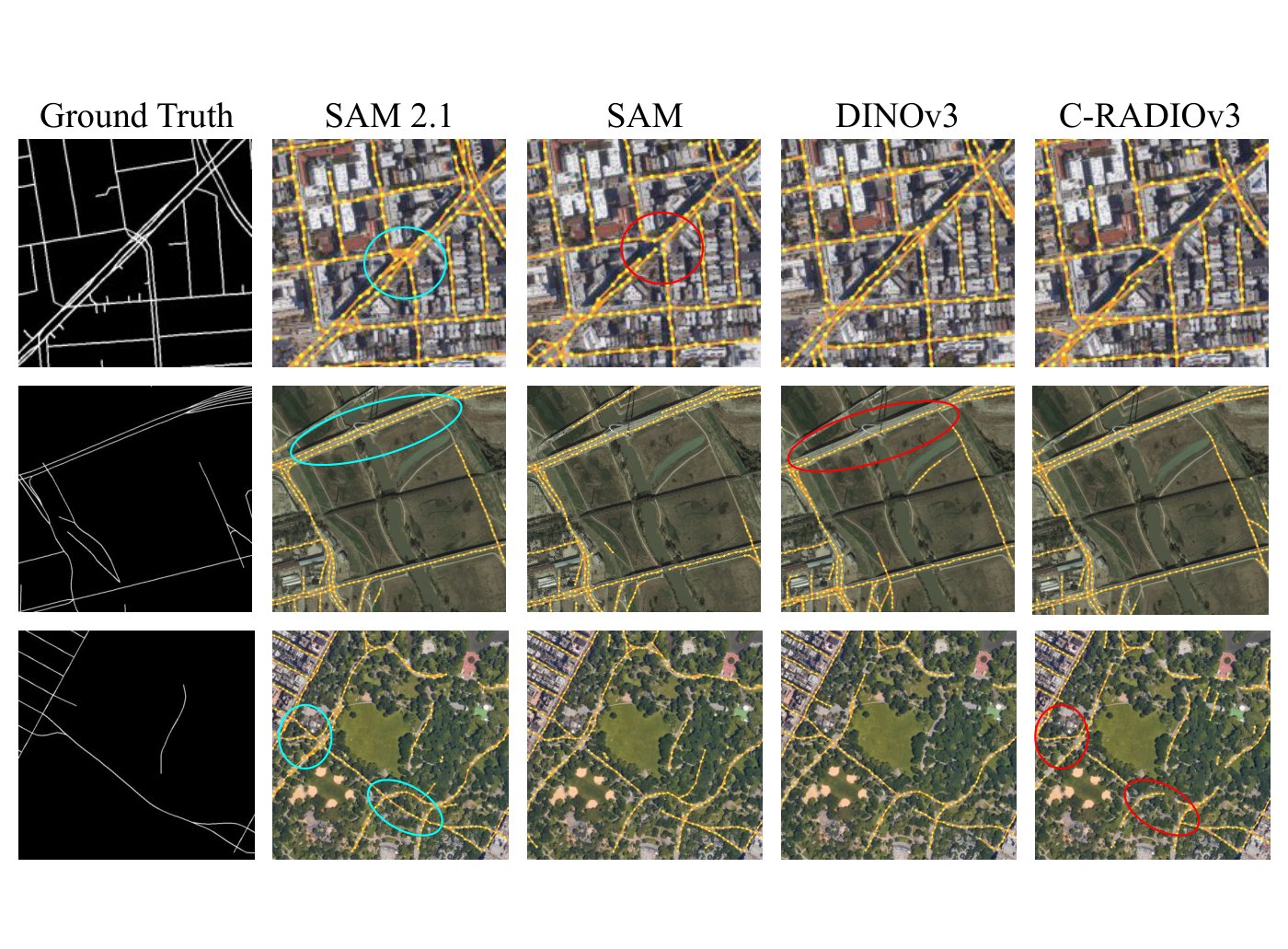
- The choice of backbone matters. SAM 2.1 gave the highest APLS, mainly by recovering roads the other encoders missed (higher recall).
- Foundation models generalize; supervised features don't. On unseen geographies the ResNet-50 baseline stays precise but its recall collapses, missing most of the network. Every foundation model held up far better.
The results are consistent with a simple hypothesis: pretraining objectives that emphasize spatial boundary localization (as in SAM 2.1) transfer better to topological routing than purely semantic or multi-teacher distilled objectives.
My role
- Led the study as first author: experimental design, every backbone and augmentation experiment, and the write-up
- Built the controlled evaluation pipeline on an NVIDIA RTX PRO 6000 GPU that isolates encoder features from the rest of the system
- Ran the cross-domain generalization study across 3,300+ globally distributed satellite tiles